Thelaserischosenforyourskin.
What changes on deeper skin tones, why the settings matter more than the machine, and what a safe course really looks like.
Laser hair removal on Indian skin: what actually matters
Laser hair removal is the most requested treatment at the clinic, and the one where people assume the machine is the whole story. It is not. On Indian skin the decision that matters is made before the machine is switched on: which wavelength, at which settings, chosen by someone qualified to read the skin in front of them.
Why does Indian skin need different laser settings?
A hair removal laser works by heating the pigment in the hair follicle until the follicle can no longer produce hair. The complication is that pigment does not only live in the follicle. Deeper skin tones carry more melanin in the surface of the skin itself, and a laser set up for lighter skin will deposit its energy there — burning or pigmenting the surface while undertreating the follicle it was aimed at.
This is why the same machine can be safe in one clinic and harmful in another. Longer wavelengths that pass through the surface pigment, conservative energy settings, effective skin cooling and a proper patch test are what make hair reduction safe on Indian skin. None of those decisions belong to the machine. All of them belong to the person operating it.
Who sets the parameters matters more than the brand on the device
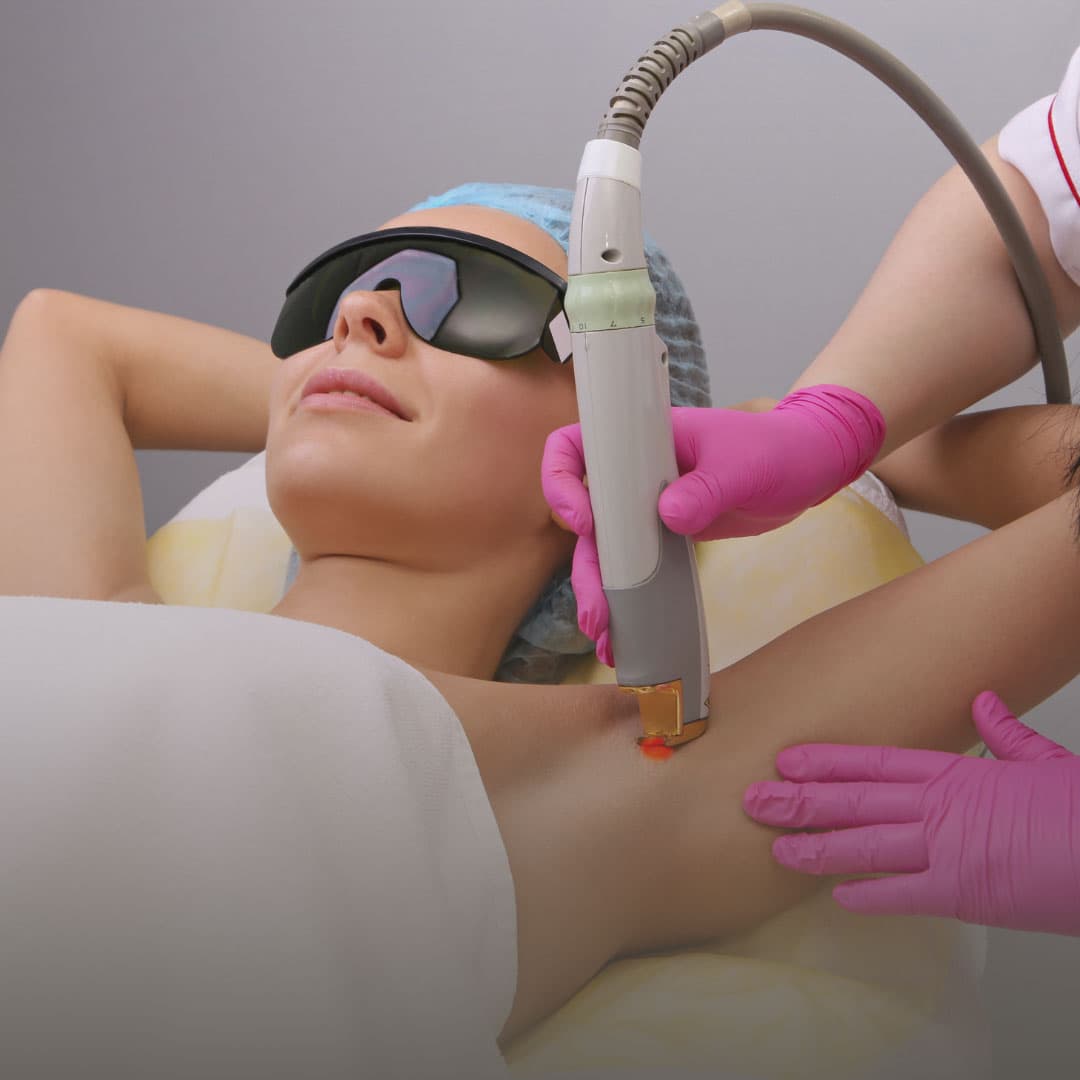
The clinic runs InMode laser platforms, and the wavelength, fluence and pulse width for every course are set by a dermatologist after examining your skin and hair — not taken from a preset. Skin tone, hair colour and thickness, the area being treated and any history of pigmentation all change the numbers. This is also why we patch test first: the response of your skin, not a chart, has the final say.
How many sessions does laser hair removal take?
A laser only affects follicles that are in their active growth phase, and at any moment only a fraction of your hair is in it. That is a fact of biology, not of any particular machine, and it is why honest courses run to six or eight sessions spaced several weeks apart rather than the three-session packages sometimes sold up front.
What you should expect from a completed course is a lasting, substantial reduction — finer, sparser, slower-growing hair, with an occasional maintenance session. "Permanent hair reduction" is the accurate term. Anyone promising one hundred percent permanent removal for every person is promising something the biology does not support.
What happens in a session?
The area is shaved and cleaned, the device settings are confirmed against your records, and the skin is cooled as the laser works. A session over a small area takes minutes; full limbs take longer. Most people describe warmth and a flicking sensation rather than pain. Mild redness around the follicles for a few hours afterwards is normal. There is no downtime, though we will ask you to avoid sun exposure and to use sunscreen — on Indian skin, sun protection around laser sessions is part of the treatment, not an afterthought.
When laser is not the right answer
Part of doing this properly is saying no. We defer or decline laser hair removal when the situation calls for it:
- During pregnancy, as a standard precaution.
- Over active infection, eczema or broken skin in the treatment area.
- On recently tanned skin, where surface melanin is temporarily raised and the burn risk with it.
- With certain medications that sensitise skin to light — always tell us what you take.
- Where excess hair growth may itself be a symptom. Sudden or severe growth, particularly with irregular cycles or acne, can point to a hormonal cause such as PCOS. That gets investigated first, because lasering the symptom of an untreated condition is doing half the job.
Hair reduction on Indian skin is a clinical decision. The wavelength, the energy and the number of sessions are set by someone qualified to read your skin.
If you are comparing clinics, the questions worth asking are not about the machine. Ask who examines your skin, who sets the parameters, whether a patch test is done, and what happens if your skin reacts. The answers tell you almost everything about how the result will look a year later.
Common questions
Is laser hair removal safe for dark or Indian skin?
Yes, when the wavelength and settings are chosen for deeper skin tones by a qualified practitioner. Indian skin carries more surface melanin, so it needs longer wavelengths, conservative energy settings, cooling and a patch test. Done that way it is safe and effective; done with settings meant for lighter skin it risks burns and pigmentation.
Is laser hair removal permanent?
The accurate term is permanent hair reduction. A completed course leaves hair substantially finer, sparser and slower growing, and many people need only an occasional maintenance session. One hundred percent permanent removal for every person is not a claim biology supports.
How many sessions will I need?
Honest courses run to six or eight sessions spaced several weeks apart, because a laser only affects follicles in their active growth phase and only a fraction of hair is in that phase at any time. The exact number depends on the area, your hair and your skin.
Does laser hair removal hurt?
Most people describe warmth and a flicking sensation rather than pain. The clinic uses skin cooling throughout, and mild redness for a few hours afterwards is the usual extent of it. There is no downtime.
Can I have laser hair removal if I have PCOS?
Often yes, and it can work well — but sudden or severe hair growth is investigated first, because it can be the symptom of a hormonal condition. Treating the cause and the hair together gives a far better long-term result than lasering alone.
Dr Nikita Gupta
Dr Gupta followed her father, a dermatologist, into the field, completing her MD in Delhi before clearing the MRCP SCE in the UK. Aesthetic fellowships in Mumbai and on Harley Street followed, then a Masters in Clinical Dermatology at King’s College London.
- MBBS · MD Dermatology
- MRCP SCE (UK)
- Masters in Clinical Dermatology, King’s College London
- Aesthetics Fellowship, Harley Street, London

Treatments this article relates to.
The clinic, on Instagram.
@thechelmerclinic




Book a consultation.
Message us on WhatsApp or call the clinic directly. Open seven days, 10am to 8pm.